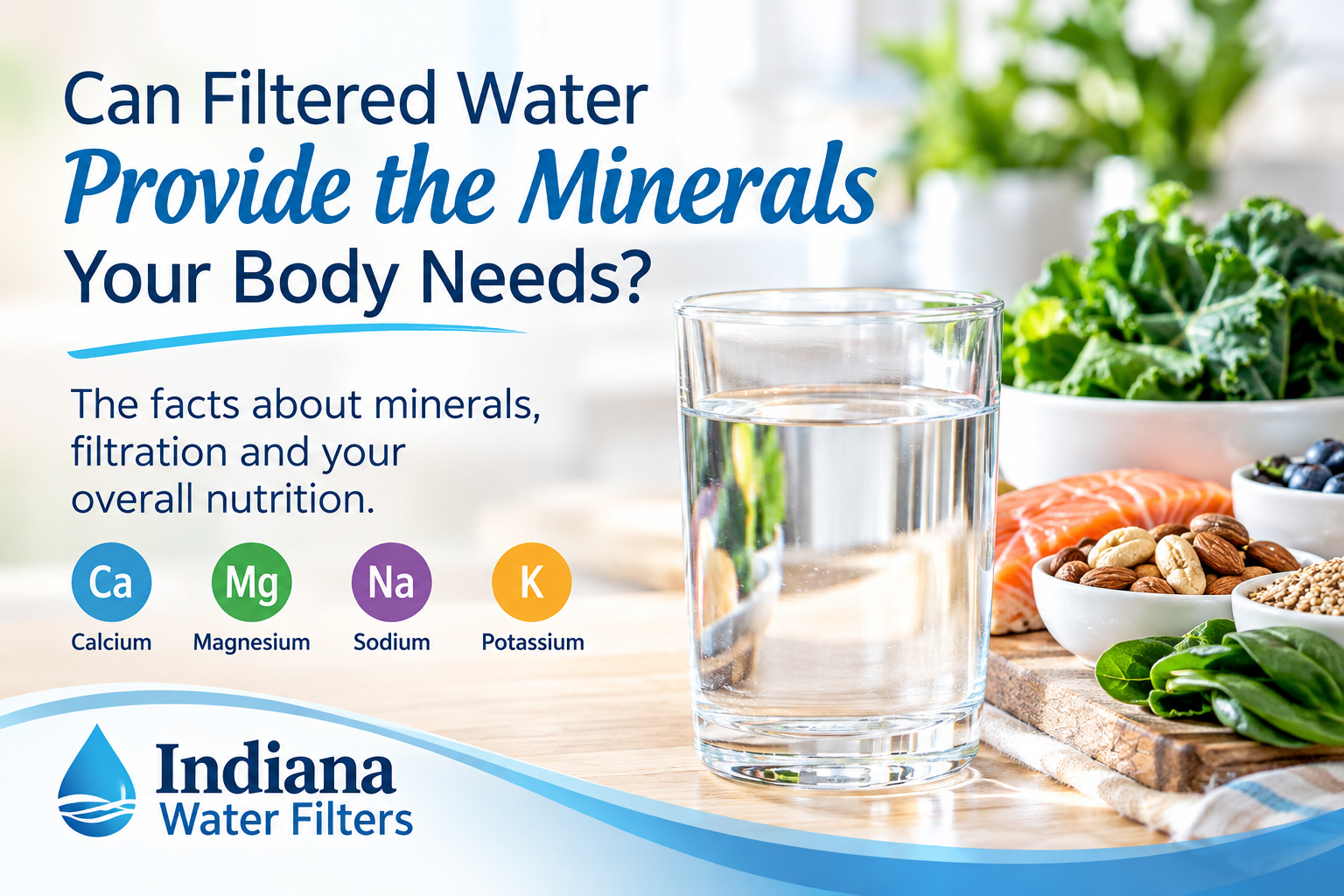
Can Filtered Water Provide the Minerals Your Body Needs?
If you’ve been researching water filtration, you’ve probably heard this question:
“Does filtering my water remove the minerals my body needs?”
It’s a reasonable question.
Minerals such as calcium and magnesium are important nutrients. They’re found in foods we eat and can also occur naturally in drinking water.
But there’s an important distinction to understand:
Not all water filters work the same way, and your drinking water is generally not the primary source of the nutrients your body needs.
Let’s take a closer look.
What Minerals Can Be Found in Drinking Water?
Natural water can pick up minerals as it moves through soil and rock.
Depending on where you live and the characteristics of your water source, drinking water may contain minerals such as:
- Calcium
- Magnesium
- Sodium
- Potassium
The amounts can vary considerably from one water source to another.
Some people therefore prefer mineral-rich water, while others prefer water that has been filtered to reduce specific contaminants.
Neither preference changes the fact that your overall diet is the major consideration when it comes to meeting your nutritional needs.
Does Water Filtration Remove Minerals?
It depends on the filtration technology.
This is where many water-filter discussions become confusing.
“Water filter” is a broad term that covers many different technologies.
Carbon Filtration
Many drinking-water filtration systems use activated carbon or similar filtration media.
These systems can be designed to reduce particular contaminants and improve taste and odor. Depending on the specific system, some dissolved minerals may remain in the water.
Reverse Osmosis
Reverse osmosis works differently.
RO systems use a semipermeable membrane and can reduce a wide range of dissolved substances, including many minerals.
This makes RO useful for certain water-treatment situations, but it also means that RO water can have a substantially lower mineral content than the source water.
Other Filtration Technologies
There are also systems using combinations of filtration technologies, specialty media, ion exchange and other processes.
The important lesson is simple:
Don’t assume that every water filter removes—or leaves behind—the same minerals.
Look at the specifications and certifications for the particular system you’re considering.
Are Minerals From Drinking Water Important?
Calcium and magnesium are certainly important nutrients.
Calcium plays an important role in maintaining bones and teeth and is involved in normal muscle and nerve function.
Magnesium is involved in numerous processes throughout the body.
But that doesn’t mean you need to rely on drinking water to obtain them.
Your diet can provide these nutrients through foods such as:
- Milk and dairy products
- Leafy green vegetables
- Beans
- Nuts and seeds
- Whole grains
- Fish
- Fortified foods
For most people, food is the more significant nutritional consideration.
Filtered Water Isn’t Supposed to Be a Multivitamin
Here’s a misconception worth clearing up:
Drinking water doesn’t need to provide all of your nutrition.
Water’s most important job is hydration.
Your meals provide your calories, protein, fats, carbohydrates, vitamins and minerals.
Think of water as one piece of the puzzle rather than the entire puzzle.
A healthy diet combined with adequate hydration is a much more meaningful goal than trying to find a water filter that delivers every nutrient your body needs.
What About “Dead Water”?
You’ve probably seen claims online that highly filtered or purified water is “dead water.”
The phrase sounds scientific, but it isn’t a nutritional or medical classification.
Water isn’t alive, and removing certain dissolved minerals doesn’t make water “dead.”
What matters is what the filtration system is designed to remove, how well it performs, and whether the resulting water is appropriate for your household.
Be cautious when you see dramatic claims that a particular type of water will “detox” your body, dramatically improve your health, or provide miraculous benefits.
Good water filtration doesn’t need exaggerated claims to be valuable.
Should You Choose Mineral Water Instead?
Not necessarily.
Mineral water, filtered tap water, purified water and other types of drinking water can all have different characteristics.
The better question isn’t:
“Which water has the most minerals?”
Instead, ask:
“What is actually in my water, and what do I want my filtration system to accomplish?”
If you’re concerned about contaminants, the first step should be understanding your water source and the contaminants that may be present.
Then you can choose filtration technology based on actual needs rather than simply choosing the system with the most minerals—or the system that removes the most substances.
Why Certifications Matter
Water filtration marketing can sometimes become confusing.
You may see phrases such as:
- “Advanced filtration”
- “Pure water”
- “Removes impurities”
- “Healthy water”
- “Mineral-rich water”
But these phrases don’t tell you exactly what a system has been tested to reduce.
That’s why independent certifications and performance claims matter.
When evaluating a drinking-water filtration system, look for information showing which contaminants the system has actually been tested and certified to reduce.
That gives you something much more useful than a vague promise of “cleaner” or “better” water.
What About Multipure?
At Indiana Water Filters, I recommend looking at filtration as a contaminant-reduction question, not simply a mineral-removal question.
Multipure drinking-water systems use carbon-block filtration technology, with specific models tested and certified for reduction of various contaminants.
That distinction is important.
Rather than trying to convince you that you need water with either “all the minerals” or “no minerals,” the goal is to choose a system that addresses the water-quality concerns that matter to you.
You can learn more about Multipure’s available systems and their specific filtration capabilities here:
Explore Multipure Water Filtration Systems
The Bottom Line
Does filtered water provide the minerals your body needs?
It can contain some minerals, depending on the source water and filtration technology—but your drinking water shouldn’t be your primary strategy for meeting your nutritional needs.
Your food provides the foundation of your nutrition.
Your water provides essential hydration.
And a properly selected water filtration system can help reduce specific contaminants while giving your household water you feel comfortable drinking every day.
The key isn’t finding the filter that removes the most or leaves the most behind.
The key is finding the right filtration technology for your water and your household.
Want to Know What’s Actually in Your Water?
Before choosing a filter, start with the water.
Check your local water-quality report, consider appropriate water testing, and identify the contaminants you want to address.
Then choose your filtration system based on evidence—not fear and not marketing hype.
Have questions about which Multipure system may fit your home? I’m happy to help you compare your options.
See Multipure Filtration Options
Indiana Water Filters is an independent Multipure distributor. Product recommendations should be based on the specific filtration needs of your household. Filtration performance varies by model and contaminant.
- Can Filtered Water Provide the Minerals Your Body Needs?

- PFAS in Indiana Drinking Water: What Homeowners Should Know

- What EPA Water Funding Changes Could Mean for Indiana Communities

- Michigan PFAS Awareness Week: Why the “Forever Chemical” Conversation Matters

- EPA Changes and Your Drinking Water: What Homeowners Need to Know