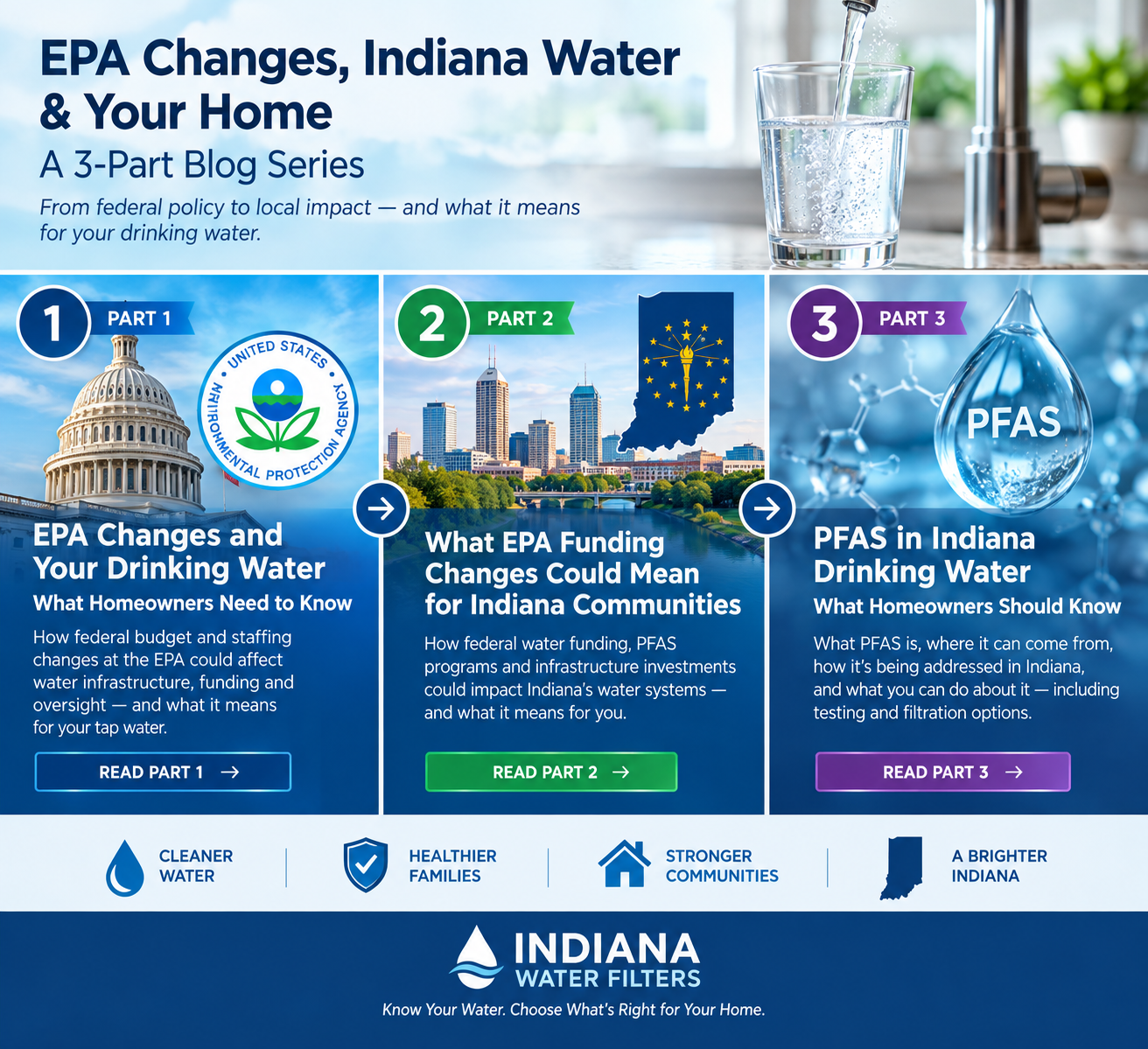
Federal water policy can sound like something that happens in Washington, D.C.
But Indiana homeowners can feel the effects much closer to home.
That’s because drinking-water infrastructure depends on a combination of federal funding, state programs, local utilities and community resources.
Indiana has its own Drinking Water State Revolving Fund, administered by the Indiana Finance Authority. The program provides financing for drinking-water infrastructure and projects addressing lead service lines and emerging contaminants.
So what happens when federal water policy changes?
Indiana Still Has Access to Major Water-Infrastructure Funding
It’s important to start with the facts.
Federal water funding has not simply disappeared.
EPA’s FY2026 State Revolving Fund allotments include money for drinking-water infrastructure, and EPA announced additional nationwide funding for lead-service-line replacement and small and rural communities.
Indiana is also receiving targeted funding.
In June 2026, EPA announced $436,000 for Indiana through a program supporting small and rural communities with drinking-water infrastructure challenges, including PFAS and lead.
And in May, EPA announced more than $13 million for Indiana through its Emerging Contaminants–Small or Disadvantaged Communities program to address PFAS and other emerging contaminants.
That’s significant because smaller communities can face unique financial and technical challenges.
Why Small and Rural Communities Matter
A large metropolitan water system may have thousands—or millions—of customers.
A small community may have far fewer.
That can make major infrastructure projects difficult to finance.
Treatment equipment, testing, engineering studies and pipe replacement can all cost substantial amounts of money.
Federal and state programs can help close that gap.
EPA has specifically identified small and rural communities as recipients of water-infrastructure assistance.
Indiana Is Also Focusing on Lead
Indiana’s FY2026 Drinking Water State Revolving Fund plan includes goals related to locating lead service lines and providing assistance for lead-service-line replacement. It also identifies PFAS remediation as an emerging-contaminant priority.
That matters to homeowners because lead-service-line problems aren’t necessarily visible.
You can’t look at a glass of water and determine whether it contains lead.
You need testing, information about the plumbing and, where applicable, replacement or treatment.
PFAS Is Another Major Issue
PFAS has become one of the most closely watched categories of drinking-water contaminants.
Indiana is receiving federal funding specifically directed toward PFAS and emerging contaminants. EPA’s May 2026 announcement allocated more than $13 million to Indiana communities through its emerging-contaminants program.
Indiana’s own DWSRF planning documents also identify PFAS remediation as a goal.
That doesn’t mean every Indiana household has a PFAS problem.
It means PFAS is an issue that water agencies are actively addressing.
What Does This Mean for Indiana Homeowners?
Your local situation matters more than a national headline.
Consider:
- Are you on city water or a private well?
- How old is your home?
- How old is the local water infrastructure?
- Is your community testing for PFAS?
- Are there known industrial or agricultural activities nearby?
- Are you concerned about lead or other contaminants?
- Has your water ever been professionally tested?
The answers can help determine whether additional filtration or testing makes sense for your household.
Don’t Confuse Infrastructure With Home Filtration
It’s also important to understand the distinction.
Community water infrastructure and a home filtration system aren’t competing solutions.
A municipal water system is responsible for treating and distributing public drinking water.
A home filter can provide an additional point-of-use or whole-home treatment step.
The appropriate system depends on the water and the contaminant you’re trying to address.
The Bottom Line for Indiana
Indiana is not being left out of the national water-infrastructure conversation.
Federal money continues to flow into the state for drinking-water infrastructure, lead and emerging contaminants, including PFAS.
At the same time, the federal government is changing how water infrastructure programs are structured and how responsibilities are shared with states.
For Indiana homeowners, that makes it more important—not less—to understand what’s happening with your local water.
Next in the series: We’ll take a closer look at PFAS, what it is, where it can come from and what Indiana homeowners can do to learn more about their own water.