Your tap water may come from a local utility, but the rules, funding, research and oversight behind that water involve more than your local water department.
The U.S. Environmental Protection Agency (EPA) plays an important role in setting drinking-water standards, supporting state and local water systems, addressing contaminants, providing funding for infrastructure and helping communities respond to water emergencies.
That makes recent changes at the EPA worth paying attention to—especially if you care about what comes out of your kitchen faucet.
But what do EPA budget and staffing changes actually mean for your water?
The answer isn’t as simple as saying, “EPA cuts mean dirty water.” The effects depend on which programs are affected, how responsibilities are shifted to states and how individual communities respond.
What Is Happening at the EPA?
The EPA has been reorganizing its workforce and changing how some environmental programs operate.
The agency’s FY2026 budget materials describe a strategy that places greater responsibility for water infrastructure funding on the states while reducing or restructuring some federal functions. EPA has also described efforts to streamline its workforce and eliminate what it considers non-essential functions.
At the same time, EPA continues to fund drinking-water programs.
For example, the agency announced nearly $2.9 billion in 2026 funding to help states identify and replace lead service lines. EPA has also announced funding for small and rural communities to improve drinking-water infrastructure and address contaminants such as PFAS and lead.
So the story isn’t simply about money disappearing.
It is about where the responsibility, money and oversight are going—and what happens when federal responsibilities are shifted toward states and local communities.
Why Does EPA Funding Matter to Your Water?
Most people don’t think about the infrastructure behind their kitchen faucet.
But before water reaches your glass, it may travel through:
- Treatment plants
- Water mains
- Storage tanks
- Pump stations
- Distribution pipes
- Lead or other older service lines
- Local plumbing
Keeping that system working requires enormous amounts of money.
EPA’s State Revolving Fund programs help finance drinking-water and wastewater infrastructure. EPA says more than $243.9 billion has historically been invested through these revolving-fund programs. Under the FY2026 approach, the agency says it is placing greater responsibility for infrastructure funding with the states.
That change matters because communities don’t all have the same financial resources.
A large city with a substantial tax base may have more options for financing major infrastructure projects than a small or rural community.
And aging infrastructure doesn’t wait for the next budget cycle.
What About PFAS?
PFAS—often called “forever chemicals”—are one of the biggest reasons many people are paying closer attention to drinking-water quality.
PFAS are a large group of manufactured chemicals that have been used in products and industrial applications for decades.
EPA’s 2026 water programs continue to address PFAS. The agency’s small and rural community grants specifically identify PFAS as one of the drinking-water challenges eligible for assistance.
But PFAS contamination can be complicated.
Testing takes money.
Treatment takes money.
Replacing contaminated infrastructure takes money.
And monitoring water supplies takes people and technical expertise.
When funding or staffing priorities change, the question isn’t simply whether PFAS regulations exist.
The bigger question is:
Will communities have the resources they need to find and address contamination?
Rural Communities Deserve Special Attention
This is particularly important in rural America.
Small water systems often have fewer customers to spread infrastructure costs across. They may also have smaller staffs and fewer technical resources.
EPA itself recognizes that small and rural water systems can face disproportionate challenges. In 2026, the agency announced more than $25 million in nationwide assistance for small and rural communities, including funding for infrastructure improvements, PFAS concerns and lead. Indiana’s allocation under that program was listed at $436,000.
EPA has also announced $30 million through its RealWaterTA initiative to provide technical assistance to small drinking-water and wastewater systems and private well owners.
That support can make a difference when a small community is trying to deal with an aging treatment plant, contaminated source water or outdated infrastructure.
What About EPA Staffing Cuts?
Funding is only part of the equation.
You also need people to do the work.
Water systems require engineers, scientists, inspectors, treatment-plant operators and other trained professionals.
EPA has been restructuring its workforce as part of a broader effort to reduce costs and change how the agency operates.
Meanwhile, the water industry itself is facing a workforce problem.
EPA says roughly one-third of the water-sector workforce is nearing retirement age, creating concerns about replacing experienced workers. In August 2026, EPA announced $10.8 million in grants aimed at strengthening the water-sector workforce.
That creates an interesting challenge:
At the same time that water infrastructure needs investment, the industry needs people with the skills to operate and maintain it.
Does This Mean Your Tap Water Is Suddenly Unsafe?
No.
It’s important not to jump from federal budget changes to the conclusion that your tap water is automatically unsafe.
Public water systems remain subject to federal and state drinking-water requirements, and local utilities continue to test and treat drinking water.
The quality of your water also depends heavily on your individual water source and distribution system.
Your local water report can tell you a lot more about your particular water supply than a national headline can.
But there is another important point:
Meeting a legal drinking-water standard and wanting additional filtration are not necessarily the same thing.
Your Water Can Change After It Leaves the Treatment Plant
Even when a water utility is doing everything required, the water entering your home can be affected by the plumbing between the treatment plant and your faucet.
Older pipes and household plumbing can introduce contaminants.
This is one reason lead-service-line replacement has become such an important issue.
EPA’s 2026 funding announcement dedicated nearly $2.9 billion to helping states identify and replace lead service lines.
If you live in an older home, knowing the age and condition of your plumbing can be just as important as knowing where your water comes from.
What Can Homeowners Do?
You don’t have to wait for Washington, your state government or your local utility to tell you everything you need to know about your water.
Start with these simple steps.
1. Find your local water quality report
If you’re on public water, look at your utility’s annual water-quality report.
Pay attention to:
- Lead
- Copper
- PFAS
- Nitrates
- Disinfection byproducts
- Other contaminants listed in the report
2. Know where your water comes from
Are you on:
- Municipal water?
- A private well?
- A community water system?
Private well owners have an additional responsibility because private wells aren’t regulated in the same way as public water systems.
3. Consider testing your water
A water-quality test can provide information specific to your home.
This can be especially useful if you have an older home, a private well or concerns about a particular contaminant.
4. Think about filtration as another layer
Water treatment at the municipal level and filtration at the point of use serve different purposes.
A properly selected home filtration system can provide an additional treatment step for drinking and cooking water.
The key is to choose a system based on the contaminants you actually want to reduce—not simply buy a filter because the packaging says “clean.”
Why This Matters in Indiana
Here in Indiana, water quality isn’t just a national issue.
It’s local.
Indiana communities depend on rivers, lakes, reservoirs, groundwater and municipal water systems. Agriculture, industry, aging infrastructure and development can all affect water resources.
And for homeowners, there is a difference between knowing that your water meets regulatory requirements and knowing exactly what is coming out of your own faucet.
That’s why staying informed matters.
The Bottom Line
The changes taking place at the EPA don’t mean that Americans should suddenly assume their tap water is unsafe.
But they do provide a reason to pay closer attention.
Federal water programs are changing. Responsibilities are shifting toward states. EPA is restructuring its workforce. At the same time, communities are dealing with aging infrastructure, PFAS, lead, emerging contaminants and a shortage of trained water professionals.
Some EPA water funding continues—and in certain areas, substantial funding is still being provided.
The bigger question is how these changes will play out over the coming years and whether states and local communities have the resources necessary to maintain and improve their water systems.
You can’t control EPA policy. You can control how informed you are about the water coming into your home.
Know your water.
Know your plumbing.
Know what contaminants may be present.
And if you want an additional layer of protection for the water you drink and cook with, consider a quality home water-filtration system designed to address the contaminants that concern you.
Want to Know More About Your Water?
At Indiana Water Filters, we believe you shouldn’t have to guess about the water your family drinks every day.
Whether you’re concerned about PFAS, lead, chlorine, sediment or simply want better-tasting drinking water, we’re happy to help you understand your options.
[Learn more about home water filtration and find the system that’s right for your home.]
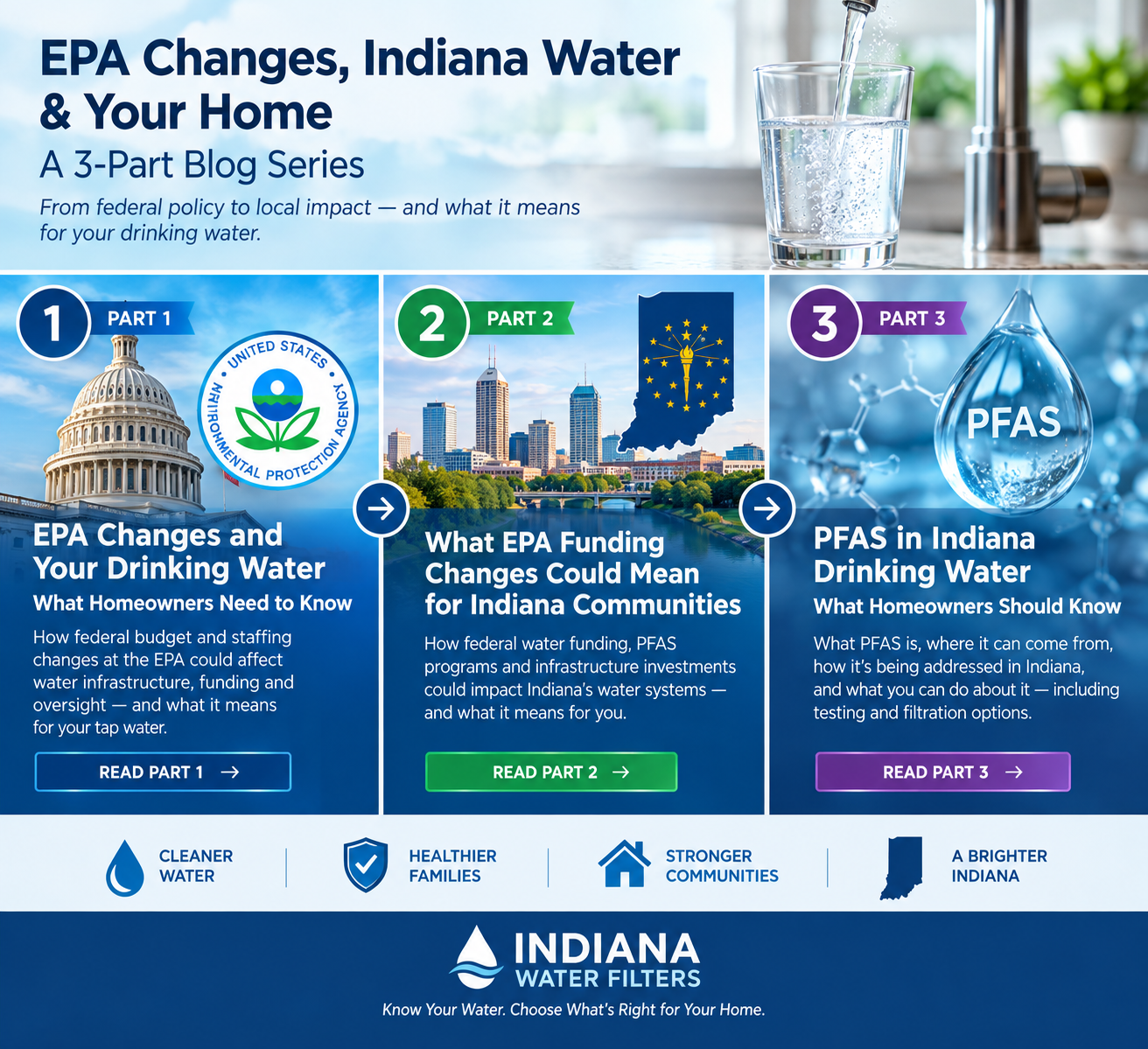
Coming Soon! Blog Series: EPA Changes, Indiana Water & Your Home