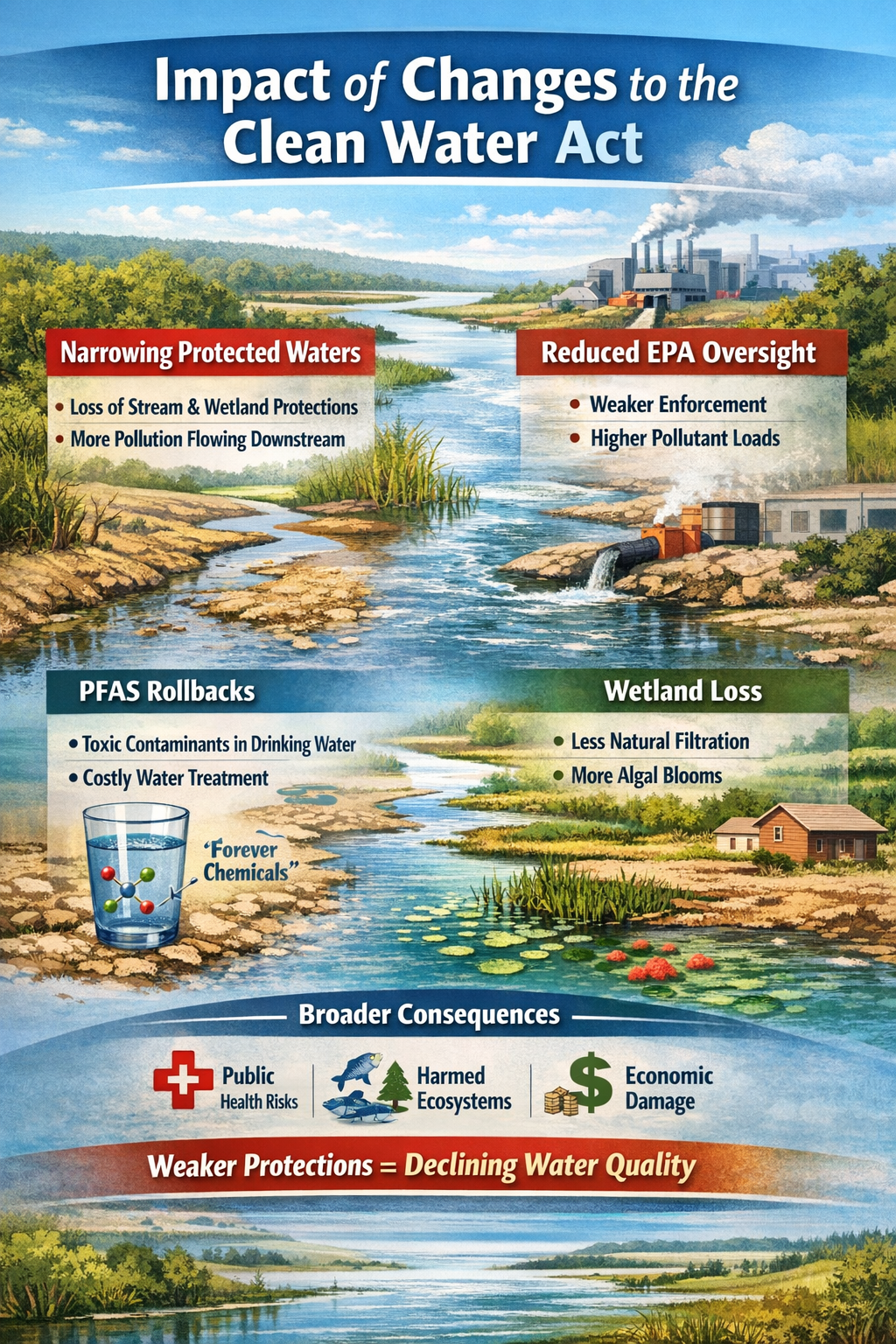
Changes to the Clean Water Act (CWA)—especially recent and proposed ones—can have significant effects on water quality in the United States. The impacts depend heavily on what the changes do: whether they weaken federal protections, maintain current safeguards, or strengthen standards to reduce pollution. Here’s a clear breakdown of how these changes are likely to affect water quality:
🧠 1. Narrowing Which Waters Are Protected
📉 What’s Changing
Federal agencies (EPA and Army Corps of Engineers) are proposing and implementing new definitions of “waters of the United States” (WOTUS) that limit which waters are protected under the Clean Water Act. Under the changes:
- Many intermittent streams, headwaters, and isolated wetlands could lose federal protection.
- Only waters with a continuous surface connection to larger navigable waters would be regulated.
🧪 How It Affects Water Quality
🌊 Increased pollution risk: Streams and wetlands that lose protection may be more vulnerable to pollution from agriculture, development, mining, and other sources, because discharges and land disturbances wouldn’t require federal permits.
💧 Downstream water quality declines: Small streams and wetlands act like nature’s filters—trapping sediments and nutrients (e.g., nitrogen and phosphorus) before they reach larger rivers and lakes. Without protection, more pollutants can flow downstream, leading to harmful algal blooms and degraded drinking water sources.
🏗️ 2. Reduced Federal Oversight and Permitting Authority
📉 Legal and Regulatory Shifts
Recent court decisions and federal actions have restricted EPA’s ability to use broad, results-based permit limits and require more specific numeric discharge limits instead. One Supreme Court ruling, for example, limited the EPA’s permitting flexibility regarding raw sewage discharge.
🧪 How It Affects Water Quality
👎 Less proactive enforcement: When regulators have narrower authority to require actions that protect water quality, pollution sources might not be held to strict standards unless specified in individual permits.
🚫 Potential for higher pollutant loads: If permits focus only on narrow numeric limits rather than overall outcomes, polluters could comply with technical terms yet still contribute to worsening water chemistry in rivers and lakes.
⚖️ 3. Rollbacks of Specific Pollution Standards
📉 PFAS (“Forever Chemical”) Regulations
The EPA has rolled back or delayed some limits on PFAS—a group of persistent toxic chemicals—in drinking water, while maintaining limits for only some of the most well-known compounds.
🧪 How It Affects Water Quality
⚠️ More contaminants entering water: Weaker or delayed regulation of PFAS can mean more of these toxic substances remain in drinking water sources longer, posing health risks like cancer, immune system harm, and developmental problems.
💵 Greater treatment costs: More pollution often means municipalities must spend more to remove contaminants, increasing public costs and possibly leading to higher water bills.
🏞️ 4. Potential Loss of Wetlands and Natural Buffers
Wetlands provide critical water filtration, flood control, and habitat protection. Proposed rules could strip protections from more than 80% of wetlands nationwide.
🧪 How It Affects Water Quality
🪸 Less filtering of runoff: Without wetland protections, more nutrients and toxins from farms, roads, and urban areas can enter waterways unabated.
💧 Higher risk of algal blooms: Nutrient pollution not filtered upstream increases the spread of harmful algal blooms, which can release toxins dangerous to humans and animals alike.
📊 Overall Likely Effects on Water Quality
| Change Type | Effect on Water Quality |
|---|---|
| Fewer federally protected waters | Likely worse—more pollution, degraded aquatic ecosystems |
| Reduced EPA regulatory authority | Risk of weakening enforcement of pollution limits |
| Rollbacks of chemical standards | Higher contaminant levels in drinking water |
| Loss of wetlands/buffers | Increased nutrient and toxin stress on rivers and lakes |
🌍 Broader Consequences
🔹 Public Health: Pollutants like nutrients, toxic metals, and chemicals can make drinking water treatment harder and more expensive, increasing health risks.
🔹 Ecosystems: Aquatic species—from fish to insects—depend on clean water and intact wetlands. Weaker protections can hasten species losses and ecological harm.
🔹 Economic Impacts: Tourism, recreation, and fishing economies depend on clean water; degraded water quality damages these sectors.
📌 Summary
Changes that weaken or narrow Clean Water Act protections—like limiting which waters are covered or rolling back pollution standards—generally lead to poorer water quality, increased pollution risks, and greater long-term costs for both ecosystems and people. Strong, science-based protections help reduce contaminants, safeguard drinking water, and preserve healthy aquatic environments.